Greek Display Font for Bold Handmade Branding
It was 10 p.m., candle wax still drying on my counter, and I was wrestling with a label mockup for my new lavender-vanilla soy blend. The name—“Moonlit Hearth”—felt warm and intentional, but the font? Flat. Lifeless. I’d cycled through three clean sans serifs and two delicate scripts, none holding the weight of what this product *is*: cozy, nostalgic, unapologetically tactile. That’s when I opened Greek—and everything clicked.
Greek for Candle Labels and Handmade Product Packaging
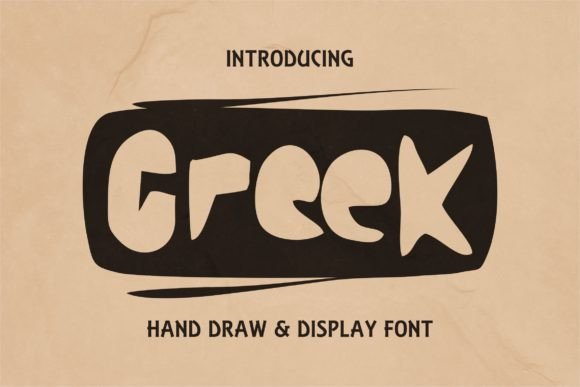
Greek is a distinctive, retro, and bulky display font that instantly elevates handmade packaging—not by whispering elegance, but by grinning with confidence. On my 2.5″ x 3.5″ kraft paper candle labels, Greek held up beautifully at 28 pt: thick strokes stayed crisp, exaggerated curves didn’t bleed or soften in print, and the vintage rhythm gave the whole label a tactile, almost hand-painted charm. Because Greek is a display font first and foremost, it shines where impact matters most—product names, scent titles (“Hearth Smoke,” “Sun-Dried Lemon”), and small-batch callouts. Just avoid cramming ingredient lists or safety warnings into Greek; its playful density isn’t built for dense text. For those, I pair Greek with a light, airy sans serif (like Montserrat Light) in the same layout—clean contrast, zero visual competition.
Greek for Wedding Invitations and Elegant Branding
I tested Greek on a digital wedding invitation suite for a client who loves mid-century modern design and farmhouse warmth. Used for the couple’s names and date—set large, centered, with generous letter spacing—it brought instant personality: bold without shouting, retro without feeling costumed. Its thick strokes hold up flawlessly in foil-stamped printing, and the exaggerated curves add subtle movement to otherwise minimalist layouts. As a fonts choice for elegant branding, Greek works best when used sparingly and intentionally—think monogrammed linen napkins, welcome sign headers, or the “RSVP” line on a pocketfold. It’s not a workhorse font, but as a premium font for high-impact moments? Absolutely. Bonus: Greek’s vintage soul pairs surprisingly well with soft serif body fonts (think Playfair Display or Cormorant Garamond) for balance and hierarchy.
Greek for Sticker Sheets and Cricut/Silhouette Projects
If you cut vinyl, print sticker sheets, or design SVG bundles for Etsy, Greek delivers strong, reliable results—but with one caveat: size matters. At 16 pt and above, Greek cuts cleanly on my Cricut Maker 3 with standard fine-point blades. Below 12 pt, inner counters (like the enclosed space in “e” or “a”) start to fill in or require manual cleanup. I recommend using Greek only for headline stickers (“YUM,” “GIFT WITH PURCHASE,” “FARMHOUSE FRESH”) and avoiding tiny decorative accents or intricate borders. Also double-check your file format: Greek comes as OTF and TTF—both compatible with Cricut Design Space and Silhouette Studio—but always install the font locally first, then type directly (don’t convert to outlines unless exporting final SVGs for commercial use). And yes—it’s licensed for commercial fonts use, so your printable sticker packs and physical sticker sheets are covered.
Greek for Printable Wall Art and Digital Downloads
Greek transforms simple phrases into statement pieces. I designed a set of 8×10” printable wall art prints around seasonal verbs—“Gather,” “Bloom,” “Pause,” “Kindle”—and Greek gave each one grounded energy. Its bulky proportions create natural visual weight, and the retro flair makes even single words feel curated, not generic. On screen and in PDF previews, Greek renders smoothly across devices, and when printed on matte cardstock or textured watercolor paper, its thick strokes absorb ink with rich, velvety depth. For digital downloads, Greek performs best in title treatments, quote headers, and cover graphics—not body copy or instruction pages. If you’re bundling Greek-based templates (planner covers, greeting card fronts, social media banners), remember to embed the font properly in PDFs or provide clear usage notes for buyers who may not own the font.
Greek for Tote Bags, Mugs, and Merchandise Design
Here’s where Greek truly flexes: on fabric and ceramic. I mocked up a black cotton tote with white Greek lettering reading “Brew & Belong”—and the result felt like something pulled from a beloved neighborhood café circa 1972. Thick strokes prevent fading or pixelation at scale, and the font’s inherent playfulness keeps merch from feeling stiff or corporate. Same goes for mugs: Greek holds up at medium sizes (1.5–2” tall) with excellent legibility from across a room. Pro tip: when prepping files for DTG or sublimation, outline Greek *only* after final sizing—its curves and stroke consistency mean less manual tweaking than many display fonts. Just remember: Greek isn’t meant for fine-detail embroidery or micro-text on jewelry tags. Save it for where boldness belongs—center stage.
Greek isn’t just another retro font. It’s a confident, joyful, tactile presence—designed to make handmade products feel more human, more memorable, more *yours*. Whether you're designing candle labels at midnight or prepping your next Etsy listing, Greek gives your work a voice that stands out—without saying a word.